
Solutions to Common Acoustic Challenges in Multi-Residential and Commercial Floor Applications
Tuesday, 28 April 2026
In multi-family and commercial projects, the acoustic performance of flooring has become a key factor—not only for compliance with standards, but above all for the actual comfort of occupants. However, despite advances in materials and systems, several challenges remain, particularly in specific applications such as ceramic tile, fitness areas, and floors with radiant heating.
The webinar “Solutions to Common Acoustic Problems in Flooring Applications for Multifamily and Commercial Buildings,” presented in collaboration with the National Floor Covering Association (NFCA), highlights a clear reality on the ground: acoustic issues are not tied to a single product, but rather to the interaction between materials, assemblies, and installation conditions.
Rethinking the Basics: Airborne Noise vs. Impact Noise
Before even discussing solutions, it is essential to fully understand the types of noise involved. Airborne noise, measured in particular by the STC rating, refers to sounds that travel through the air, such as voices or music. Conversely, impact noise—measured by indices such as IIC or AIIC—is transmitted directly through the building’s structure.
However, in most cases observed in the field, it is impact noise that generates the most complaints. It is even estimated that it accounts for up to 80% of acoustic issues in buildings.
This distinction is fundamental, as it directly influences the choice of solutions. All too often, systems that perform well against airborne noise fail to provide real comfort because impact noise has not been adequately addressed.
Ceramic Tiles: Performance and Technical Constraints
The use of ceramic tiles over large areas, particularly in multi-unit residential buildings, poses significant acoustic challenges. Their natural rigidity and low absorption capacity promote the transmission of impact noise to the structure.
The webinar presents a comparative study conducted on various types of acoustic underlays, including rubber solutions, fiber-based systems, and dry screed approaches. The results clearly show that performance varies considerably from one solution to another, and that certain configurations stand out with significant acoustic gains.
One particularly interesting finding emerges: systems using fibers (such as needle-punched fiber membranes or solutions based on recycled wood fibers) can offer superior performance, even compared to thicker or denser materials.
This challenges a perception still widespread in the industry, namely that mass or thickness is the primary factor in acoustic performance.
Training Facilities: The Challenge of Extreme Impacts
Fitness centers are among the most demanding environments in terms of floor acoustics. The impacts generated—dropping weights, dynamic movements—produce significant vibrations, particularly at low frequencies, which easily transmit to the structure and adjacent spaces. To address this, a variety of technologies are now available, ranging from specialized floor coverings to more complex multi-layer systems.
A key concept to understand is the difference between force reduction and energy dissipation. Some materials absorb impact to limit vibration transmission, while others dissipate part of the energy. In a multi-unit residential setting, the goal is generally to maximize absorption in order to reduce disturbances for occupants.
Solutions also vary depending on the project context. In new construction, high-performance systems can be integrated from the design phase. In renovation, height, weight, and structural constraints often limit options. Solutions range from simpler ones costing around $10 to $12 per square foot to much more comprehensive and high-performance systems.
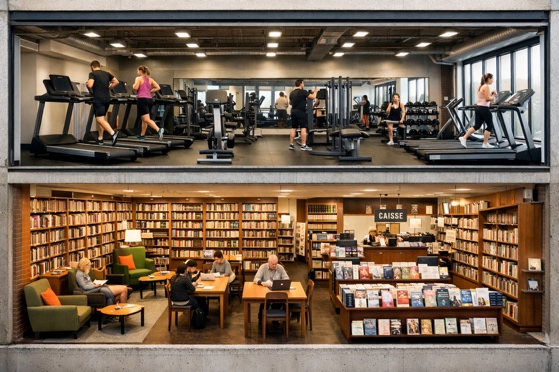
A telling example is a training facility located above a library—a scenario we’ve encountered before. In this type of critical situation, a complete system (isolators, structure, concrete, finish) can cost around $120/sq ft, but delivers truly
effective acoustic performance. This clearly illustrates a reality: the greater the constraints, the more comprehensive and integrated the solution must be from the outset.
Radiant Floor Heating: A Compromise to Master
The integration of radiant floor heating systems adds an additional layer of complexity that is often underestimated. While these systems improve thermal comfort, they have a direct impact on acoustic performance.
The data presented shows that, on average, adding a heating system can result in a loss of approximately 5 AIIC points. This decrease is primarily due to an increase in the assembly’s rigidity. The more rigid a system is, the more it transmits vibrations. This phenomenon is particularly critical in configurations without suspended ceilings, where impacts are both audible and perceptible.
However, solutions exist. Certain geotextile membranes, for example, help limit these losses by maintaining a good level of decoupling. The recommended approach is to treat heating systems as a standalone acoustic challenge, rather than as a simple technical addition.
A Data- and Systems-Based Approach
One of the webinar’s key messages is the importance of relying on reliable and comparable data. With over 3,000 tests conducted and more than 25 years of expertise, AcoustiTECH’s approach is based on the analysis of actual performance rather than on assumptions.
This allows for a better understanding of the discrepancies between laboratory performance and that observed in the field, where phenomena such as flanking sound transmission strongly influence the results.
In this context, apparent indices (ASTC, AIIC) become essential for evaluating the overall performance of an assembly under real-world conditions.
In conclusion: design intelligently to avoid compromises
Acoustic challenges related to floors are not new, but they evolve with construction trends and occupant expectations. The increased use of ceramic tiles, the integration of training spaces, and the popularity of underfloor heating systems create new constraints that require a more rigorous and integrated approach.
The good news is that solutions exist. But their effectiveness depends directly on understanding the issues and integrating them from the earliest stages of the project.
Today, it’s no longer just about meeting code requirements; it’s about delivering comfortable, sustainable, and high-performance environments. Because when it comes to acoustics, what is anticipated can be managed… and what is overlooked comes at a cost.
Watch the full webinar replay here.

Andre Rioux
Co-Owner / Executive Vice-President Marketing
AcoustiTECH